Biz Boost DIY
Isabgol Farming Made Easy – The Complete Beginners Guide
Isabgol Farming Made Easy – The Complete Beginners Guide
Couldn't load pickup availability


Isabgol Farming Made Easy – Complete Guide to Growing, Harvesting, Processing and Selling Isabgol in India
Turn Isabgol Farming into a Planned Agricultural Business – From Seed to Mandi
Isabgol, also known as psyllium or Plantago ovata, is one of India's important commercial crops. Its seeds and husk are supplied to pharmaceutical companies, nutraceutical manufacturers, food businesses and international markets.
India plays a major role in the global psyllium industry, creating opportunities for farmers and agricultural entrepreneurs who understand how to cultivate, handle and market this valuable crop.
But successful isabgol farming requires more than putting seeds in the ground.
You need to know whether your land is suitable, which variety to choose, how much investment is required, when to irrigate, how to protect the crop, when to harvest and where to sell your produce.
That's why we created Isabgol Farming Made Easy.
This comprehensive, beginner-friendly ebook takes you through the complete seed-to-market journey, helping you understand both the agricultural and business sides of isabgol farming in India.
Whether you are an experienced farmer, a landowner, a young agricultural entrepreneur or someone exploring a new farming opportunity, this guide brings the essential information together in one place.
What Makes This Guide Different?
1. Understand the Isabgol Business Opportunity
Before investing in any crop, you need to understand its market and business potential.
Discover why India is a major supplier of psyllium to the global market and explore the opportunities available across cultivation, trading and processing.
Learn about:
- India's position in the global isabgol industry
- Major isabgol-producing states and districts
- The importance of Unjha mandi
- Domestic and international market demand
- Different types of isabgol buyers
- The value of raw seed compared with processed husk
- Potential opportunities and risks for growers
2. Learn Isabgol Cultivation Step by Step
Understand the complete cultivation process, from selecting your land to managing the crop throughout the growing season.
Explore:
- Climate and soil requirements
- Land selection and field preparation
- Recommended isabgol varieties
- Seed selection and sowing techniques
- Irrigation scheduling
- Nutrient and weed management
- Pest and disease management
- Organic cultivation considerations
- Harvesting and post-harvest practices
The guide explains the important crop stages so you can better plan your field activities throughout the season.
3. Understand Your Investment and Profit Potential
How much does it cost to grow isabgol? What yield can you expect? How do you calculate your potential profit?
This ebook breaks down the financial side of cultivation so you can plan your investment more carefully.
Learn about:
- Per-acre cultivation expenses
- Seed, fertiliser and labour costs
- Irrigation and other input expenses
- Expected seed yield
- Gross income and estimated net returns
- Different farming and grower models
- Cost and yield calculations
- Factors that affect profitability
You will also explore illustrative financial scenarios to understand how yield, selling price and cultivation costs influence your final returns.
All financial figures are estimates, not guaranteed earnings. Actual results depend on location, weather, crop management, input costs and prevailing market prices.
4. Discover the Business Beyond Raw Isabgol Seeds
Isabgol farming does not have to end with selling raw seeds.
The ebook introduces you to the wider value chain, including the products created through cleaning and processing.
Explore opportunities involving:
- Raw isabgol seed
- Cleaned and graded seed
- Different grades of psyllium husk
- Psyllium husk powder
- Seed kernel and by-products
- Processing and packaging
- Direct supply to processors
- Organic production opportunities
Understand how the value chain works and what it takes to explore opportunities beyond traditional mandi sales.
5. Learn Where and How to Sell Your Produce
A good harvest is only part of a successful farming business. Knowing your buyers and understanding the market are equally important.
Learn about:
- Unjha and other important isabgol mandis
- APMC trading opportunities
- Psyllium processors
- Domestic buyers and traders
- Export-oriented businesses
- Direct buyer enquiries
- Price comparison and negotiation
- Direct-sale considerations
The guide also includes a directory of research stations, markets, agencies and buyers to help you explore useful industry contacts.
6. Get Practical Farming Tools and Templates
This isn't just a book to read and put away.
It includes 15 practical resources that can help you organise your cultivation activities, maintain records, calculate costs and plan your sales.
From a cost and yield calculator to crop calendars, field records and buyer enquiry templates, these resources are designed to help you apply what you learn.
Imagine This…
You own a piece of agricultural land and are considering growing isabgol during the rabi season.
Before investing, you evaluate your soil, climate and water availability. You select a suitable variety, estimate your cultivation expenses and prepare a realistic farming budget.
Once sowing begins, you follow an organised crop-management schedule, monitor irrigation requirements and keep track of weeds, pests and diseases.
As the crop approaches maturity, you prepare for harvesting, drying, cleaning and grading.
Instead of rushing to sell your produce, you compare available mandi rates, explore processor contacts and evaluate direct-selling opportunities.
With a better understanding of the business, you can also consider whether cleaning, grading or husk processing could become part of your future plans.
That's the difference between simply growing a crop and understanding the business behind it.
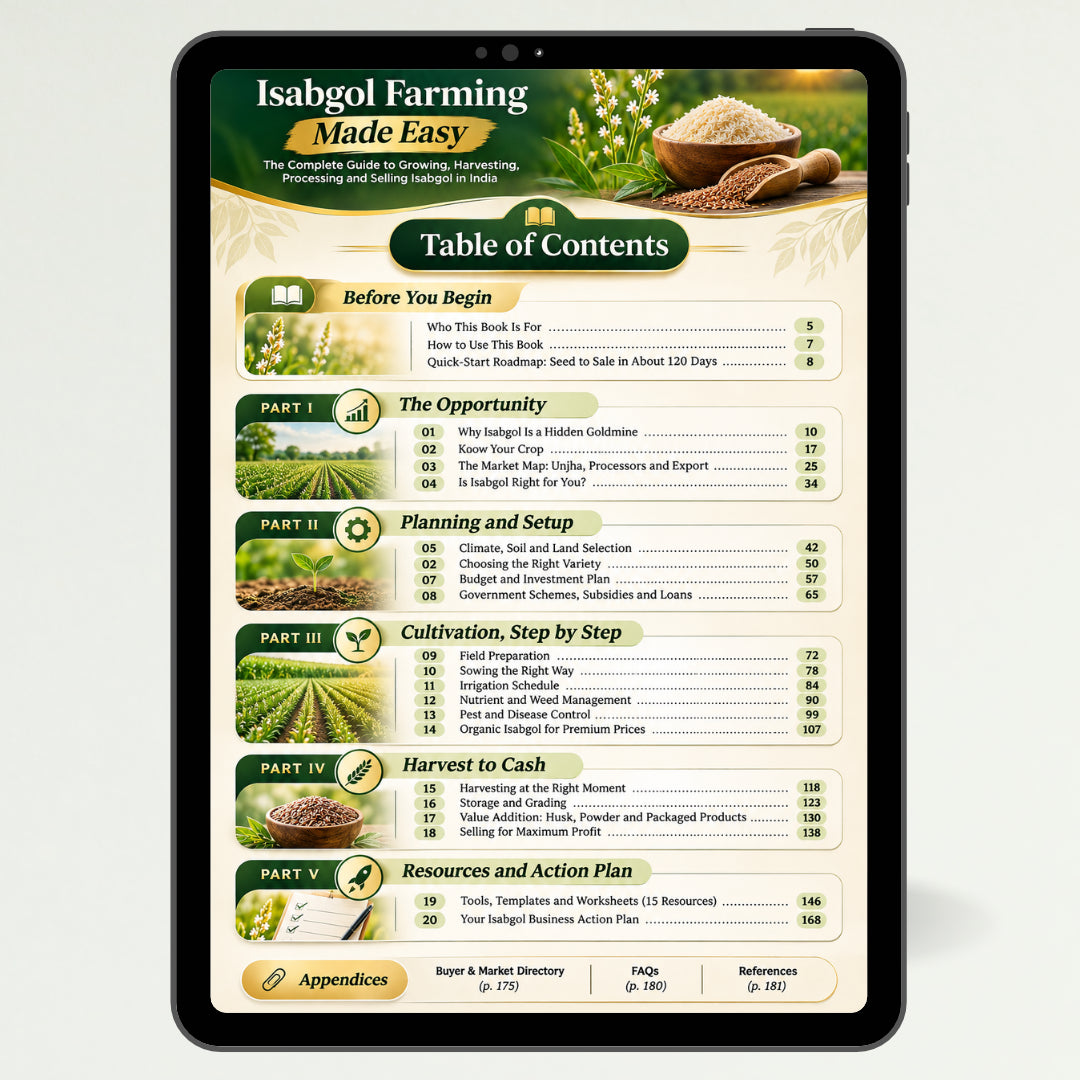
What's Inside? A Chapter-by-Chapter Breakdown
The ebook contains 20 practical chapters organised into five parts, taking you from understanding the opportunity to planning your next season.
PART I: THE OPPORTUNITY
Chapter 1: Why Isabgol Is a Hidden Goldmine
Discover why isabgol is an important commercial crop for India. Understand its global market position, potential returns from one acre, the value chain from raw seed to branded husk and the major risks growers should consider.
Chapter 2: Know Your Crop
Understand the isabgol plant, its botanical characteristics, life cycle, seed structure and the value of its husk. Learn how seed quality influences processing, husk recovery and market value.
Chapter 3: The Market Map: Unjha, Processors and Export
Explore India's isabgol trading ecosystem, the role of Unjha mandi, major processing centres, different buyer categories and the movement of isabgol from farms to domestic and international markets.
Chapter 4: Is Isabgol Right for You?
Evaluate whether isabgol suits your land, region, resources and farming goals. Understand the practical requirements, potential challenges and considerations before deciding how much land to cultivate.
PART II: PLANNING AND SETUP
Chapter 5: Climate, Soil and Land Selection
Learn about suitable climatic conditions, soil characteristics, drainage, land preparation considerations and how to evaluate your farm before planting.
Chapter 6: Choosing the Right Variety
Explore isabgol varieties, their characteristics, suitability, crop duration and yield potential. Understand why selecting quality seed is important for establishing a healthy crop.
Chapter 7: Budget and Investment Plan
Plan your cultivation budget by understanding the expenses involved in seed, land preparation, fertilisers, labour, irrigation and other agricultural inputs. Learn how to estimate your investment before sowing.
Chapter 8: Government Schemes, Subsidies and Loans
Explore relevant government support, agricultural schemes, subsidy opportunities and financing considerations that may help growers plan their farming activities.
PART III: CULTIVATION, STEP BY STEP
Chapter 9: Field Preparation
Understand how to prepare your land for isabgol cultivation, including ploughing, manure application, levelling and preparing suitable beds for sowing.
Chapter 10: Sowing the Right Way
Learn about seed selection, seed treatment considerations, seed rates, sowing methods, proper distribution and the steps involved in establishing your crop.
Chapter 11: Irrigation Schedule
Understand the crop's irrigation requirements at different growth stages. Learn about light irrigation, moisture management and avoiding waterlogging.
Chapter 12: Nutrient and Weed Management
Explore nutrient requirements, fertiliser planning, top-dressing, weed management and the importance of maintaining healthy crop growth during the early stages.
Chapter 13: Pest and Disease Control
Understand common isabgol crop problems, including downy mildew, aphids and other potential threats. Learn about monitoring, preventive practices and responsible crop-protection management.
Chapter 14: Organic Isabgol for Premium Prices
Explore organic isabgol cultivation, certification considerations, potential market opportunities and the requirements involved in supplying certified organic produce.
PART IV: HARVEST TO CASH
Chapter 15: Harvesting at the Right Moment
Learn how to identify crop maturity, understand harvesting conditions, reduce seed shattering and protect your harvest from avoidable losses.
Chapter 16: Storage and Grading
Understand proper drying, cleaning, grading and storage practices. Learn why moisture management and seed quality matter when preparing your produce for buyers.
Chapter 17: Value Addition: Husk, Powder and Packaged Products
Discover how raw isabgol seed moves through the processing stage to become psyllium husk and powder. Explore processing methods, product grades, packaging and value-addition opportunities.
Chapter 18: Selling for Maximum Profit
Explore mandi sales, direct buyer relationships, price comparisons, processor connections and practical selling strategies to help you make more informed market decisions.
PART V: SCALE AND SUCCEED
Chapter 19: Profit Calculations and Grower Models
Understand different grower models and financial scenarios. Learn how cultivation costs, yield, selling prices, land arrangements and farming methods influence your potential returns.
Chapter 20: Your 12-Month Action Plan and Scaling Up
Bring your knowledge together with a practical action plan. Learn how to organise your farming activities, review your results, improve operations and plan for future growth.
15 Ready-to-Use Tools, Templates and Resources Included
Your ebook also includes 15 practical resources to help you put the information into action.
- Cost and Yield Calculator – Estimate cultivation expenses, expected income and potential returns.
- Printable Crop Calendar – Organise important crop activities and seasonal stages.
- Field Diary Template – Maintain records of your field activities.
- Input and Spray Record – Track agricultural inputs and crop-protection applications.
- Germination Test Record – Monitor and record seed germination results.
- Harvest and Lot Register – Maintain organised harvest and produce records.
- Sales Record – Track your produce sales and transactions.
- Pre-Sale Price Check – Compare available prices before selling.
- Buyer Enquiry Message Template – Prepare enquiries for potential buyers.
- Direct Sale Agreement Checklist – Review important considerations before entering a direct-sale arrangement.
- End-of-Season Review – Evaluate your season and identify areas for improvement.
- Directory: Research Stations, Markets, Agencies and Buyers – Explore useful agricultural and industry contacts.
- Glossary – Understand important isabgol and farming terminology.
- Frequently Asked Questions – Find answers to common questions about isabgol farming.
- Key References – Explore the reference materials used in the guide.
Who Is This Ebook For?
This guide is designed for people who want to understand isabgol farming from both an agricultural and business perspective.
It is particularly useful for:
- Farmers looking to explore isabgol as a commercial rabi crop.
- First-time growers who want to understand cultivation before investing.
- Landowners interested in making productive use of their agricultural land.
- Young agricultural entrepreneurs exploring opportunities in farming and agribusiness.
- FPOs and farmer groups interested in aggregation, grading and market access.
- Traders and business owners who want to understand the isabgol value chain.
- Processing entrepreneurs exploring psyllium seed, husk and powder opportunities.
- The guide focuses on Indian farming conditions, markets and business opportunities.
Why You Shouldn't Start Without Understanding the Crop
Isabgol offers interesting agricultural and business opportunities, but farming always involves uncertainty.
Weather, especially rain and heavy dew near harvest, can affect seed quality and cause significant losses. Mandi prices fluctuate, and yields depend on several factors, including soil, seed quality and crop management.
Before investing, understand:
- Whether your land and climate are suitable.
- Which variety may work best for your region.
- How much money you need to begin.
- Which crop stages require the most attention.
- How to protect your crop near harvest.
- Where you can sell your produce.
- Whether processing or value addition makes sense for your business.
A well-planned farming decision starts with the right information.
Get Your Copy of Isabgol Farming Made Easy Today
Here's what you will receive:
✔ 183-page practical isabgol farming ebook
✔ 20 detailed chapters covering the complete seed-to-market journey
✔ Step-by-step cultivation guidance
✔ Soil, climate and variety selection information
✔ Investment planning and profit calculations
✔ Irrigation, nutrient, weed and crop-management guidance
✔ Harvesting, drying, storage and grading techniques
✔ Isabgol husk and processing opportunities
✔ Unjha mandi, buyer and market information
✔ 15 ready-to-use tools, templates and resources
✔ 19 charts and diagrams
✔ A practical 12-month action plan
✔ Instant digital download
Read it on your laptop, tablet or smartphone, and refer to the practical resources whenever you need them.
Don't just grow isabgol. Understand how the entire business works.
Limited-time offer: Use code FIRST10 to get 10% OFF your first ebook.
Get your digital copy today and take the first step towards planning your isabgol farming journey.
Important: This ebook is intended for educational and informational purposes. Farming involves financial risk, and no yield or income is guaranteed. Prices, costs, and scheme information can change. Always verify current local agricultural recommendations, product labels, mandi rates, and government requirements before making decisions.